Struggling to master German articles der die das? You’re not alone! Understanding when to use der (masculine), die (feminine), and das (neuter) is one of the most challenging aspects of learning German grammar. That’s why we’ve created this comprehensive FAQ page to answer your most common questions. Whether you’re a beginner or looking to refine your skills, our guide is here to make learning der, die, das easier and more intuitive. Dive in to explore tips, tricks, and expert answers to your burning questions!
FAQ Resource List for Der Die Das:
Our Article Game with pre-built “German Articles”
Online dictionaries like Duden and Leo with article lookups.
Mastering Der Die Das: Practical Exercises
Understanding the rules is one thing—applying them is another. Here are some practical exercises to help solidify your knowledge of der die das:
- Label Your Surroundings:
- Write down the German words for items around your home or office (e.g., der Tisch for table, die Lampe for lamp, das Fenster for window).
- Use sticky notes to label these items, ensuring you include the correct article.
- Flashcards with Articles:
- Create flashcards for common German nouns, writing the article on one side and the noun on the other.
- Test yourself by guessing the article before flipping the card.
- Fill-in-the-Blank Sentences:
- Complete sentences like:
- “___ Haus ist groß.” (Answer: Das)
- “Ich sehe ___ Baum.” (Answer: Den)
- “___ Katze sitzt auf dem Stuhl.” (Answer: Die)
- Complete sentences like:
Common Mistakes with Der Die Das
Avoid these pitfalls when learning der, die, das:
- Assuming Gender Based on English:
- Just because “sun” is feminine in English doesn’t mean it’s die Sonne in German! (Actually, it is—but not all translations match so neatly.)
- Skipping the Article:
- Some learners focus on the noun and ignore the article. This leads to confusion when forming sentences. Always learn nouns with their articles!
- Forgetting to Adjust in Cases:
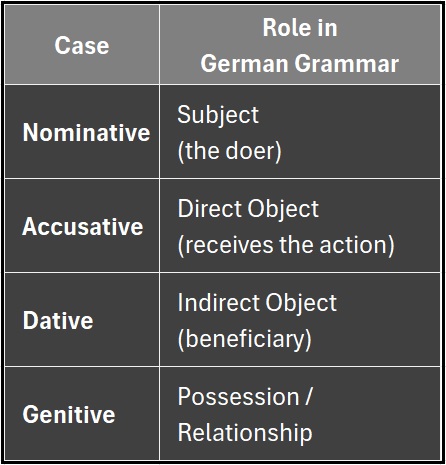
- Remember, articles change in the nominative, accusative, dative, and genitive cases. For example:
- Nominative: Der Mann
- Accusative: Den Mann
- Remember, articles change in the nominative, accusative, dative, and genitive cases. For example:
Tips for Memorizing German Articles
- Use Mnemonics:
- Create funny or memorable associations for tricky words. For instance:
- Das Mädchen (the girl): Think “Girls like small things,” and das is used for diminutives.
- Create funny or memorable associations for tricky words. For instance:
- Practice with Native Speakers:
- Join language exchange platforms or practice with friends. Hearing and using articles in context helps reinforce them.
- Focus on Patterns:
- Words ending in -heit, -keit, and -ung are almost always die. Words ending in -chen or -lein are almost always das.
Expand Your Vocabulary
Boost your fluency by learning new words along with their articles. our Mind Maps and German Short Stories help in this regard. Here are some examples:
- Der (Masculine):
- Der Hund (dog)
- Der Baum (tree)
- Der Computer (computer)
- Die (Feminine):
- Die Blume (flower)
- Die Tür (door)
- Die Uhr (clock)
- Das (Neuter):
- Das Auto (car)
- Das Buch (book)
- Das Kind (child)
Resources to Help You Master Der Die Das
Here are some additional tools to improve your understanding of der die das:
- derdiedasgerman.com: Explore more blog posts, quizzes, and guides designed to make learning German articles straightforward and fun.
- Duden Online: A trusted online dictionary for checking noun genders and usage.
- Language Apps:
- Try apps like Duolingo or Memrise to practice articles with interactive exercises.
- YouTube Channels:
- Watch German language tutorials focused on grammar and articles. Channels like “Learn German with Anja” often provide practical tips.
- Reading Material:
Final Thoughts on Der Die Das
Learning der die das takes time, but with consistent practice and exposure, it becomes second nature. Keep revisiting the rules, practicing with real-world examples, and testing yourself. Remember, mistakes are part of the learning process—don’t be afraid to get it wrong as you strive to get it right.
If you have more questions, feel free to reach out or explore additional resources on our site. Happy learning!