What is the Dativ Case in German: Free Interactive Trainer & Clear Guide
Feeling a bit wobbly with German cases? You’re not alone! After tackling the Nominative, the Dativ Case in German (der Dativ) is often the next hurdle for learners. But what exactly is it, and why does German even need it?
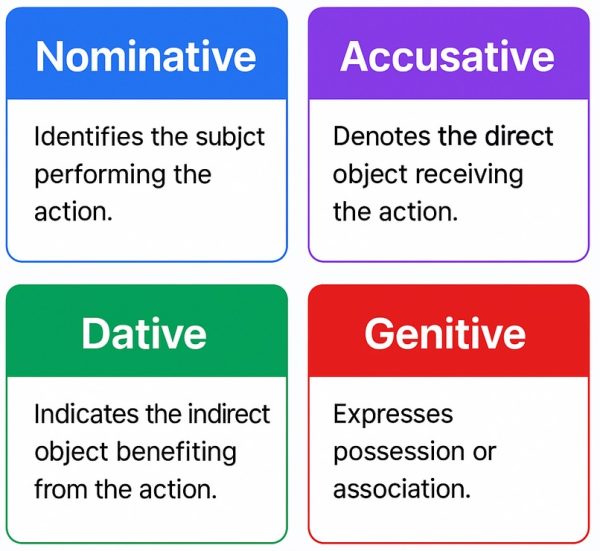
Think of the Dativ Case in German as the “indirect object” case. While the Accusative case often marks the direct recipient of an action (who or what is being seen, read, eaten), the Dative case frequently indicates the person or thing to whom or for whom an action is done. It answers the crucial question: Wem? (To whom? / For whom?).
Mastering the Dativ case in German is essential for building correct and natural-sounding German sentences. It’s used with specific verbs, follows certain prepositions, and is vital for expressing relationships between nouns in a sentence.
This guide will break down the Dative case step-by-step. We’ll cover:
- What the Dative case signifies (The “Why”)
- How articles change in the Dative (The “How”)
- When you absolutely must use the Dative (The “When”)
- A Free Interactive Dative Case Trainer to practice what you’ve learned!
Let’s dive in and make the Dative your friend!
(Replace “The Why: Understanding the Role of the Accusative Case”)
The Why: Understanding the Role of the Dativ Case in German
The primary role of the Dative case is to mark the indirect object in a sentence. The indirect object is typically the recipient or beneficiary of the action directed towards the direct object.
Ask yourself: Wem? (To whom? / For whom?) is the action happening? The answer is usually in the Dative case.
Consider this:
- Ich gebe dem Mann das Buch. (I give the book to the man.)
- Was gebe ich? (What do I give?) -> das Buch (The book – direct object, Accusative)
- Wem gebe ich das Buch? (To whom do I give the book?) -> dem Mann (The man – indirect object, Dative)
Many common German verbs inherently require a Dative object, even if there isn’t an Accusative direct object present. These verbs often involve actions directed towards or affecting a person.
Examples of common Dative verbs:
- helfen (to help): Ich helfe dir. (I help you.) – Wem helfe ich? -> dir (Dative)
- danken (to thank): Sie dankt dem Lehrer. (She thanks the teacher.) – Wem dankt sie? -> dem Lehrer (Dative)
- gefallen (to please/be liked by): Das Auto gefällt meiner Schwester. (My sister likes the car. Lit: The car pleases my sister.) – Wem gefällt das Auto? -> meiner Schwester (Dative)
- gehören (to belong to): Das Buch gehört dem Studenten. (The book belongs to the student.) – Wem gehört das Buch? -> dem Studenten (Dative)
Understanding that the Dative often points to the recipient or the entity affected indirectly by the verb is key.
(Replace “The How: Accusative Article Changes”)
The How: Dativ Case in German Article Change
Okay, you know when to use it. Now, how do words change?

This is where things get interesting! Unlike the Accusative, where only the masculine articles change significantly, the Dative case affects articles for all genders and plural. You need to memorize these changes:
Let’s look at the changes:
Definite Articles (the): Nominative vs. Dative
| Gender | Nominative (Subject) | Dative (Indirect Object – “Wem?”) | Change? |
| Masculine | der Mann | dem Mann | Yes (der->dem) |
| Feminine | die Frau | der Frau | Yes (die->der) |
| Neuter | das Kind | dem Kind | Yes (das->dem) |
| Plural | die Leute | den Leuten | Yes (die->den + Noun+n) |
Indefinite Articles (a/an): Nominative vs. Dative
| Gender | Nominative (Subject) | Dative (Indirect Object – “Wem?”) | Change? |
| Masculine | ein Mann | einem Mann | Yes (ein->einem) |
| Feminine | eine Frau | einer Frau | Yes (eine->einer) |
| Neuter | ein Kind | einem Kind | Yes (ein->einem) |
| Plural | keine Leute* | keinen Leuten* | Yes (keine->keinen + Noun+n) |
* (Note: There’s no direct plural for “ein/eine”. We often use keine (no/none) or just the noun. Possessives like meinen Freunden follow the den pattern).
Key Takeaways for Dative Article Changes:
- All Genders Change: Masculine (dem), Feminine (der), Neuter (dem), and Plural (den) articles are different in the Dative compared to the Nominative.
- Masculine & Neuter: Both take dem (definite) or einem (indefinite). Easy to group!
- Feminine: Takes der (definite) or einer (indefinite). Be careful not to confuse Dative der with Nominative masculine der!
- Plural: Takes den (definite/possessive/kein-) AND often adds an -n to the noun itself if it doesn’t already end in -n or -s (e.g., die Kinder -> den Kindern, die Freunde -> den Freunden).
These changes also apply to possessive pronouns (mein, dein, sein, etc.) and the negative article kein. Examples: meinem Bruder (to my brother), seiner Tante (to his aunt), ihrem Kind (to her child), unseren Freunden (to our friends), keinem Problem (to no problem).
(Replace “When to Use the Accusative Case”)
When to Use the Dative Case in German
Now that you know the “why” and “how,” let’s look at the specific situations (“when”) that demand the Dative case:
1. After Specific Dative Verbs
Many German verbs always take an object in the Dative case. This object is often the person experiencing or receiving something. You simply have to memorize these verbs!
Common Dative Verbs include:
- helfen (to help): Ich helfe dem alten Mann. (I help the old man.)
- danken (to thank): Wir danken Ihnen für Ihre Hilfe. (We thank you for your help.)
- gefallen (to please, be liked by): Die Musik gefällt mir. (I like the music.)
- gehören (to belong to): Das Fahrrad gehört meinem Bruder. (The bicycle belongs to my brother.)
- glauben (to believe someone): Sie glaubt ihm nicht. (She doesn’t believe him.)
- gratulieren (to congratulate): Ich gratuliere dir zum Geburtstag! (I congratulate you on your birthday!)
- passen (to fit, to suit): Die Schuhe passen dem Kind. (The shoes fit the child.)
- schmecken (to taste good to): Der Kuchen schmeckt uns gut. (The cake tastes good to us.)
- vertrauen (to trust): Er vertraut seinem Gefühl. (He trusts his feeling.)
- zuhören (to listen to): Hörst du mir bitte zu? (Are you listening to me, please?)
- antworten (to answer someone): Er antwortet der Professorin. (He answers the professor (fem.).)
- folgen (to follow): Folgen Sie dem Schild. (Follow the sign.)
2. As the Indirect Object (Recipient/Beneficiary)
With verbs that take two objects (a direct object in Accusative and an indirect object in Dative), the Dative marks the recipient or beneficiary.
Common Verbs taking Accusative (Direct Obj.) + Dative (Indirect Obj.):
- geben (to give): Sie gibt dem Freund (Dat) ein Geschenk (Acc). (She gives the friend a present.)
- zeigen (to show): Ich zeige den Touristen (Dat) die Stadt (Acc). (I show the tourists the city.)
- schicken (to send): Er schickt seiner Mutter (Dat) eine Karte (Acc). (He sends his mother a card.)
- bringen (to bring): Bringst du mir (Dat) bitte Wasser (Acc)? (Will you bring me water, please?)
- kaufen (to buy for): Wir kaufen unserem Sohn (Dat) ein Buch (Acc). (We buy our son a book.)
- erzählen (to tell): Oma erzählt den Kindern (Dat) eine Geschichte (Acc). (Grandma tells the children a story.)
- sagen (to say to): Ich sage dir (Dat) die Wahrheit (Acc). (I tell you the truth.)
3. After Specific Dative Prepositions
Certain prepositions always require the noun that follows them to be in the Dative case. Memorize this list!
The main Dative Prepositions are:
- aus (from, out of): Er kommt aus der Schweiz. (He comes from Switzerland.) / Sie nimmt es aus dem Schrank. (She takes it out of the cupboard.)
- außer (except for, besides): Alle außer meinem Bruder sind gekommen. (Everyone except my brother came.)
- bei (at, near, with, at the house of): Ich bin beim Arzt (bei dem Arzt). (I am at the doctor’s.) / Sie wohnt bei ihren Großeltern. (She lives with her grandparents.) / Bei diesem Wetter bleiben wir drinnen. (In/With this weather, we stay inside.)
- mit (with, by means of): Wir fahren mit dem Auto. (We travel by car.) / Spielst du mit mir? (Are you playing with me?)
- nach (after, to – for cities/countries/directions): Nach der Arbeit gehe ich einkaufen. (After work, I go shopping.) / Wir fliegen nach Italien. (We fly to Italy.) / Gehen Sie nach links. (Go left.)
- seit (since, for – duration up to now): Er lernt Deutsch seit einem Jahr. (He has been learning German for a year.) / Sie ist seit letzter Woche krank. (She has been sick since last week.)
- von (from, by, of): Das ist ein Geschenk von meiner Tante. (That is a gift from my aunt.) / Ich komme vom Bahnhof (von dem Bahnhof). (I am coming from the train station.) / Ein Freund von mir wohnt hier. (A friend of mine lives here.)
- zu (to, at, for – purpose): Ich gehe zum Supermarkt (zu dem Supermarkt). (I am going to the supermarket.) / Wir sind zu Hause. (We are at home.) / Das ist gut zum Frühstück. (That is good for breakfast.)
- gegenüber (opposite, towards – can come before or after the noun): Er sitzt mir gegenüber. (He sits opposite me.) / Dem Haus gegenüber ist ein Park. (Opposite the house is a park.)
4. With Two-Way Prepositions (Wechselpräpositionen) Indicating Location
These are the tricky ones! Certain prepositions can take either the Accusative or the Dative case. The rule is:
- Accusative: Used when there is motion or direction towards a place. (Answers: Wohin? – Where to?)
- Dative: Used when describing a static location or position. (Answers: Wo? – Where?)
The Two-Way Prepositions are: an, auf, hinter, in, neben, über, unter, vor, zwischen.
Examples showing Dative (Location):
- an (on vertical/boundary): Das Bild hängt an der Wand. (The picture hangs on the wall.) – Wo hängt das Bild?
- auf (on horizontal): Das Buch liegt auf dem Tisch. (The book lies on the table.) – Wo liegt das Buch?
- hinter (behind): Der Stuhl steht hinter dem Schreibtisch. (The chair stands behind the desk.) – Wo steht der Stuhl?
- in (in): Wir sind im Kino (in dem Kino). (We are in the cinema.) – Wo sind wir?
- neben (next to): Sie sitzt neben ihrem Freund. (She sits next to her friend.) – Wo sitzt sie?
- über (over, above): Die Lampe hängt über dem Esstisch. (The lamp hangs above the dining table.) – Wo hängt die Lampe?
- unter (under): Die Katze schläft unter dem Bett. (The cat sleeps under the bed.) – Wo schläft die Katze?
- vor (in front of): Dein Auto steht vor meiner Garage. (Your car is parked in front of my garage.) – Wo steht dein Auto?
- zwischen (between): Das Geschäft ist zwischen der Bank und der Post. (The shop is between the bank and the post office.) – Wo ist das Geschäft?
Mastering these specific verbs, prepositions, and the location rule for two-way prepositions is crucial for using the Dative case correctly.
Free Interactive Dative Case Trainer
Ready to put your knowledge to the test? Theory is great, but practice makes perfect!
Use our interactive trainer below to drill the Dative case. You’ll see sentences with a missing article or pronoun. Choose the correct Dative form from the dropdown menu based on the noun’s gender and the context (verb or preposition). Get instant feedback and explanations to help you learn from your mistakes.
“`htmlDative Case Trainer
Conclusion: The Dative is Doable!
The Dativ case in German might seem complex initially with its varied triggers – specific verbs, dedicated prepositions, indirect objects, and location rules for two-way prepositions. However, by understanding its core function (often marking the recipient or the answer to “Wem?”), memorizing the article changes, and learning the key verbs and prepositions, you can definitely master it.
Don’t be discouraged if you make mistakes. German cases take time and consistent exposure.
We have another tool
This helps with understanding the different declensions
Click here for the tool
What Are German Dative Verbs?
German dative verbs are verbs that require their objects to be in the dative case,
like helfen (to help) or danken (to thank). Mastering these
German dative verbs is essential for speaking natural German. Read More…
Practice Makes Perfect
Becoming Fluent In German: 180 Intermediate Short Stories

Complete German Grammar, 2nd Edition
Clicking and purchasing through these links supports our site and helps us continue creating fun, effective learning experiences without any cost to you—Danke schön!
Try Our Other German Learning Games
Now that you’ve had a blast with our crosswords, why not try our other games to boost your German skills even more? Explore additional challenges, expand your vocabulary, and enjoy every step of your language journey!