Why Learn German? 3 Powerful Reasons (+ Career & Travel Benefits)
If you’re wondering why learn German, the answer is clear: German stands as one of the most valuable languages to learn in today’s interconnected world, spoken by over 100 million native speakers and serving as the most widely spoken native language in Europe. Whether you’re driven by career ambitions, intellectual curiosity, or cultural enrichment, mastering German opens doors that few other languages can match. Here are three powerful reasons why learning German deserves your time and effort
This site contains affiliate links. If you click and make a purchase, I may receive a commission at no extra cost to you. I only recommend resources I believe are helpful for learning German.


Why Learn German?:
Career Opportunities and Economic Advancement
Learning German dramatically expands your professional horizons, particularly in one of the world’s strongest economies. Germany maintains its position as the largest European trading partner with the United States and hosts global powerhouses like BMW, Volkswagen, Adidas, and Lufthansa. The numbers tell a compelling story: 97% of jobs in Germany require German language proficiency, and speaking German can increase your earnings by up to 20% compared to non-German speakers with identical qualifications.
The advantage extends beyond Germany’s borders into Austria, Switzerland, and Luxembourg, creating a vast professional network across Central Europe. For entrepreneurs, Berlin’s vibrant startup scene offers an ideal environment to launch innovative ventures, and German language skills provide direct access to investors and business partners in this dynamic market. Industries ranging from automotive and engineering to finance, IT, and pharmaceuticals actively seek German-speaking professionals, giving you a competitive edge in the global job market.
To build the grammar foundation that employers value, practice with our German Declension Tool and master the cases that make German communication precise and professional. Additionally, strengthen your sentence construction skills with our Nominative Case Practice to ensure you can express yourself accurately in business contexts.
Why Learn German?:
Access to World-Class Education and Research
Germany offers exceptional educational opportunities, with many universities providing tuition-free or low-cost programs—even for international students. However, to fully capitalize on these opportunities, German language proficiency proves essential, as numerous programs and courses are conducted in German. Strong command of the language ensures you can participate fully in lectures, understand subject-specific texts, and access scholarly articles and research resources written in German.
Beyond formal education, German grants you direct access to groundbreaking scientific and technological journals, expanding your research capabilities significantly. The language serves as a gateway to academic resources that remain untranslated, giving you an advantage in fields where German-speaking researchers have made pioneering contributions. This academic access translates into scholarships, grants, and research collaboration opportunities that are often reserved for German speakers.
Build your vocabulary systematically using our German Word Match Game to recognize academic terminology quickly. Master the crucial definite articles with our Der Die Das Quiz Game, since proper article usage is fundamental to academic German. For comprehensive case practice, try our interactive trainers for the Accusative Case and Dative Case, which are essential for understanding complex academic texts.
Why Learn German?:
Rich Cultural Heritage and Intellectual Tradition
German culture has profoundly shaped Western civilization through extraordinary contributions to philosophy, literature, music, and science. Learning German grants you direct access to the original works of philosophical giants like Kant, Nietzsche, Hegel, and Schopenhauer, whose ideas have influenced modern thought across disciplines. The German literary tradition encompasses writers who explored human existence with remarkable depth, from Goethe and Schiller to Thomas Mann and Hermann Hesse, and reading these authors in their original language reveals nuances that translations inevitably lose.
The relationship between German literature and philosophy creates a uniquely rich intellectual landscape. German Romantic writers and thinkers developed concepts of artistic genius and human creativity that continue to resonate today, while 19th-century German literature performed the Hegelian task of modern self-understanding in deeply reflective ways. Understanding German allows you to engage with cultural traditions and social nuances that have shaped not only German-speaking countries but European culture as a whole.
Learning German also facilitates integration when traveling or living in German-speaking regions, enabling you to communicate authentically with locals and immerse yourself in social life. The language provides confidence and adaptability as you navigate daily situations, build friendships, and participate in cultural experiences that remain inaccessible to non-speakers.
Enhance your reading comprehension through our Short German Stories, which feature handy word lists with English translations and article variations to help you understand authentic sentence structures. Expand your vocabulary playfully with our Crossword Puzzles that challenge your brain while building practical language skills. For verb mastery, practice with our Conjugations Game focusing on essential pronouns and verb forms.
Learning German represents an investment in your professional future, intellectual development, and cultural enrichment. The language challenges your brain in ways that boost cognitive abilities and strengthen overall language learning skills. With dedication and the right learning tools, you’ll unlock opportunities that transform both your career trajectory and personal worldview. Start your German journey today and discover why millions worldwide choose to master this powerful, influential language.
Frequently Asked Questions About Why Learn German
The time required depends on your target proficiency level and study intensity. According to the US Foreign Service Institute, English speakers need approximately 750 hours of classroom study—roughly seven months of consistent practice—to reach conversational fluency.
Breaking this down by level: A1 (Beginner) requires 70-150 hours, A2 (Elementary) needs 150-260 hours, B1 (Intermediate) takes 300-490 hours, B2 (Upper Intermediate) requires 530-620 hours, and C1 (Advanced) demands 600-750 hours. With intensive study of 20-30 lessons per week, you can complete each level in approximately 6-8 weeks.
Practice consistently with our German Declension Tool and Der Die Das Quiz Game to accelerate your learning and master fundamental grammar concepts efficiently.
German is not as difficult as many people assume. The US Foreign Service Institute classifies German as a Category II language, meaning it shares moderate similarity with English and requires less time to learn than languages like Arabic, Chinese, or Japanese. Both German and English belong to the Germanic language family, which means they share considerable vocabulary and grammatical structures.
The main challenges include German’s four grammatical cases (Nominativ, Akkusativ, Dativ, Genitiv), three grammatical genders (der, die, das), and verb conjugations. However, these grammatical complexities become manageable with structured practice. The close relationship between English and German offers significant advantages, particularly with verb patterns and word etymology.
Build confidence with our case-specific practice tools: Nominative Case Practice, Accusative Case Trainer, and Dative Case Trainer to systematically master German grammar.
German proficiency follows the Common European Framework of Reference for Languages (CEFR), which divides language ability into six levels. A1 (Beginner) covers basic phrases and simple interactions. A2 (Elementary) allows you to handle routine tasks and describe your background. B1 (Intermediate) enables you to deal with most travel situations and express opinions on familiar topics.
B2 (Upper Intermediate) means you can interact with native speakers with reasonable fluency and understand complex texts. C1 (Advanced) represents fluent, spontaneous communication in social, academic, and professional contexts. C2 (Mastery) indicates near-native proficiency with nuanced expression.
Most universities in Germany require B1 or TestDaF 3 level for admission, depending on your chosen program. Each level builds systematically on the previous one.
Track your progress across all levels using our German Word Match Game and Crossword Puzzles to build vocabulary at every stage.
Yes, online German learning can be highly effective when combined with quality resources and consistent practice. Online courses offer flexibility to study at your own pace while accessing structured curricula that follow the CEFR framework. The key to success with online learning is choosing courses that provide comprehensive explanations, plenty of exercises, and opportunities for active practice.
Effective online learning requires self-discipline and regular study sessions. Interactive tools that provide immediate feedback help reinforce concepts and identify areas needing improvement. From your first lessons, quality online programs enable you to start reading, writing, and speaking German immediately.
Supplement your online learning with our free interactive tools at DerDieDasGerman.com, including our Conjugations Game for verb practice and Short German Stories with English translations.
Consistent, targeted practice with immediate feedback proves most effective for mastering German grammar. Focus on understanding the fundamental structures—particularly the four grammatical cases and three genders—before attempting complex sentence construction. Breaking grammar study into manageable chunks and practicing each concept until it becomes automatic helps prevent overwhelm.
Interactive exercises that test your understanding in context are more valuable than passive memorization. Starting with simple sentences and gradually increasing complexity allows you to build confidence while developing accuracy. Embracing the intricacies of German grammar—including verb conjugations, cases, word order, and noun genders—transforms the learning journey into a rewarding experience.
Our comprehensive practice tools make grammar mastery systematic and engaging: use our German Declension Tool for article and adjective endings, practice all three cases with dedicated trainers, and test your knowledge with our Der Die Das Quiz Game.

What to Expect from the DerDieDasGerman Free German Word Match Game:
- Completely FREE German Game: No hidden costs, just pure free German learning fun!
- Easy to Play: Jump right in and start playing – no complicated instructions needed. It’s intuitive and user-friendly.
- Perfect for All German Learners: Beginner to intermediate learners will find this German vocabulary game beneficial for building a solid foundation and expanding their word knowledge.
- Learn German Anywhere: Play it on your computer, tablet, or phone – learn German on the go! Practice your German vocabulary anytime, anywhere.
Ready to ditch the boring flashcards and embrace a more enjoyable and effective way to learn German vocabulary and der, die, das?

Click here to play the FREE German Word Match Game now and start having fun while learning!
Give our German word game a try and let me know what you think! We’re always looking for ways to make learning German more accessible and enjoyable, and we hope this game helps you on your language journey. Viel Spaß! (Have fun!)
Continue your learning journey with our FREE GAME!
PLAY our Definite Articles Game!

Here are a few other learning materials that will help with your journey:
Becoming fluent in German: 150 Short Stories
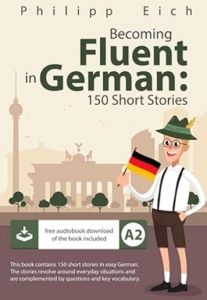
Short Stories in German for Beginners