Free German Declension Tool for Practice & Examples
Mastering German declensions is a pivotal step in achieving fluency in the language. Declensions affect articles, adjectives, and pronouns, altering their forms to convey grammatical relationships within sentences. This guide offers a comprehensive overview, complete with an interactive declension table, to support your learning journey
What are German Declensions and Cases?
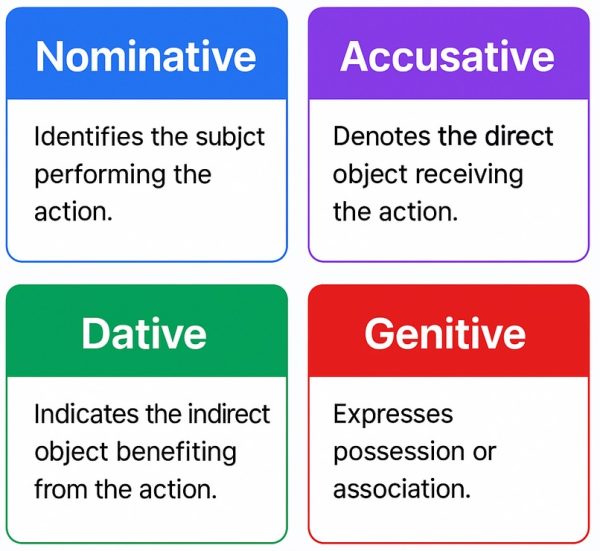
Understanding German Declensions and Cases:
- Nominative: This is the doer — the person or thing doing something.
- Example: The dog runs. (“The dog” is doing the running.)
- Accusative: This is the receiver — the person or thing that the action is happening to.
- Example: I see the dog. (“The dog” is being seen.)
- Dative: This is the helper — the one who gets something or benefits.
- Example: I give the dog a bone. (“The dog” gets the bone.)
- Genitive: This shows belonging — like saying something belongs to someone.
- Example: The dog’s bone is big. (The bone belongs to “the dog.”)
Think of them like characters in a story:
- Nominative = the hero
- Accusative = the target
- Dative = the gift-getter
- Genitive = the owner
German Declensions
Definite Articles (“the”)
The definite articles in German change based on the case and gender of the noun:
| Case | Masculine | Feminine | Neuter | Plural |
|---|---|---|---|---|
| Nominative | der | die | das | die |
| Accusative | den | die | das | die |
| Dative | dem | der | dem | den |
| Genitive | des | der | des | der |
Indefinite Articles (“a”/”an”)
Similarly, indefinite articles adapt to the noun’s case and gender:
| Case | Masculine | Feminine | Neuter | Plural |
|---|---|---|---|---|
| Nominative | ein | eine | ein | keine |
| Accusative | einen | eine | ein | keine |
| Dative | einem | einer | einem | keinen |
| Genitive | eines | einer | eines | keiner |
Adjective Endings
Adjective endings in German are influenced by the presence and type of articles:
- Strong Inflection: Used when no article precedes the adjective.
- Weak Inflection: Occurs when a definite article precedes the adjective.
- Mixed Inflection: Applies when an indefinite article or possessive pronoun precedes the adjective.
For instance, in the nominative case:
- Strong: guter Wein (good wine)
- Weak: der gute Wein (the good wine)
- Mixed: ein guter Wein (a good wine)
Interactive Declension Table
To facilitate your understanding, here’s an interactive table illustrating the declension of the masculine noun Mann (man):
| Case | Definite Article | Indefinite Article | Adjective | Noun |
|---|---|---|---|---|
| Nominative | der | ein | gute | Mann |
| Accusative | den | einen | guten | Mann |
| Dative | dem | einem | guten | Mann |
| Genitive | des | eines | guten | Mannes |
This table demonstrates how articles and adjectives change according to the case.
Practice Makes Perfect
Becoming Fluent In German: 180 Intermediate Short Stories

Complete German Grammar, 2nd Edition
Clicking and purchasing through these links supports our site and helps us continue creating fun, effective learning experiences without any cost to you—Danke schön!
Try Our Other German Learning Games
Now that you’ve had a blast with our crosswords, why not try our other games to boost your German skills even more? Explore additional challenges, expand your vocabulary, and enjoy every step of your language journey!