Do You Want to Know What Are the Four German Noun Cases?
If you’ve ever asked yourself, “What Are the Four German Noun Cases?”, you’re in the right place. Mastering these cases—nominative, accusative, dative, and genitive—will help you form clear, correct sentences in German grammar. In this guide, we’ll break down each case step by step, show you how to recognize them, and provide practical tips for quick learning. By the end, you’ll know exactly what the four German noun cases are and how to use them confidently.
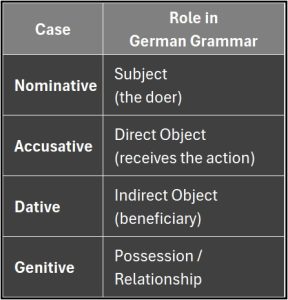
Table of Contents
- Why Understanding German Noun Cases Matters
- What Are the Four German Noun Cases?
- Quick Reference Chart
- Practical Tips for Mastery
- Conclusion
Why Understanding German Noun Cases Matters
In German grammar, noun cases determine how words change depending on their function in a sentence. If you know what the four German noun cases are, you can quickly identify the subject, direct object, indirect object, and expressions of possession. This skill helps you speak and write more naturally in German, avoiding common mistakes with articles, adjectives, and declensions.
What Are the Four German Noun Cases?
<img src=”yourimage.jpg” alt=”Infographic: What Are the Four German Noun Cases” width=”600″ />
Each German noun case answers a specific question about a sentence:
1. Nominative Case
- Function: Marks the subject of the sentence.
- Answers: “Who?” or “What?” is doing the action.
- Example:
- Der Mann (Nominative) trinkt Wasser.
(The man drinks water.)
- Der Mann (Nominative) trinkt Wasser.
2. Accusative Case
- Function: Marks the direct object.
- Answers: “Whom?” or “What?” is directly affected by the action?
- Example:
- Ich sehe den Hund (Accusative).
(I see the dog.)
- Ich sehe den Hund (Accusative).
3. Dative Case
- Function: Marks the indirect object.
- Answers: “To whom?” or “For whom?” is something given?
- Example:
- Sie gibt dem Kind (Dative) ein Geschenk.
(She gives the child a present.)
- Sie gibt dem Kind (Dative) ein Geschenk.
4. Genitive Case
- Function: Expresses possession or close relationships.
- Answers: “Whose?”
- Example:
- Das Auto des Mannes (Genitive) ist schnell.
(The man’s car is fast.)
- Das Auto des Mannes (Genitive) ist schnell.
Quick Reference Chart for German Noun Cases
| Case | Role in German Grammar | Key Question | Example |
|---|---|---|---|
| Nominative | Subject (the doer) | Who? / What? | Der Mann isst Brot. |
| Accusative | Direct Object (receives the action) | Whom? / What? | Ich sehe den Mann. |
| Dative | Indirect Object (beneficiary) | To whom? / For whom? | Ich gebe dem Mann ein Buch. |
| Genitive | Possession / Relationship | Whose? | Das Buch des Mannes ist neu. |
This table highlights what the four German noun cases do, helping you see their unique roles in a sentence.
Practical Tips for German Noun Cases
- Identify the Sentence Roles
Before you decide which German noun case to use, identify the subject, direct object, indirect object, and expressions of possession. - Memorize Articles and Endings
Nouns and their articles (der/die/das) change forms in different cases. The same goes for adjectives and determiners—pay attention to their endings. - Practice with Real-Life Sentences
Reinforce what the four German noun cases are by reading German texts or watching German videos. Each time you see a noun, ask yourself which case it’s in and why. - Use Color-Coding
Assign a color to each case (e.g., red for accusative, blue for dative) to visualize changes in articles, declensions, and word endings. - Review Regularly
Repetition is crucial in language learning. Set aside time each day to review your notes on German grammar, focusing on the nominative, accusative, dative, and genitive.
Conclusion
So, do you want to know what are the four German noun cases? Now you have the answer—nominative, accusative, dative, and genitive—along with clear examples to guide your learning. Understanding these cases is essential for mastering German sentence structure and improving your fluency. Bookmark this page, share it with fellow learners, and revisit it often to reinforce your knowledge of German noun cases.
Ready to Take the Next Step?
Subscribe to our newsletter for more insights on German grammar, declensions, and effective language-learning tips. By staying updated, you’ll continue to refine your skills and gain confidence in speaking and writing German!
Disclaimer
I am not a certified teacher or language professional—just an enthusiastic learner sharing my research and study methods publicly. The information provided on this site is based on personal study, online resources, and educational materials. While I strive for accuracy, language rules can be complex, and official guidelines may change. I encourage you to do your own research, consult trusted educational sources, and verify information when studying for exams like the AP German exam.
Additional learning materials to help you Learn How to Speak German with Confidence
Becoming fluent in German: 150 Short Stories

Short Stories in German for Beginners


PLAY our Definite Articles Game! (more advanced)